 Add to Chrome
 Add to Firefox
 Add to Edge
When Think-with-Image Meets Safety: What Determines Multimodal Jailbreak Robustness?
May 27, 2026
Think-with-image reasoning is emerging as a new inference paradigm for large vision-language models, but its safety implications remain poorly understood. Existing systems already span multiple process designs, including direct response generation, text-only prior turn, visual-state manipulation, and explicit external image-tool invocation. In this paper, we ask which of these evaluated paradigms improves multimodal jailbreak robustness, and why. Across multiple vision-language models, explicit image-tool interaction yields the lowest attack success rates in our experiments, reducing jailbreak success by around 30% relative on average across the evaluated models. This finding is initially surprising: ASR remains low even when the returned image-tool output is manually overridden or itself unsafe-looking, but returns near direct-answering levels under text-only prior turn controls. These results indicate that the lower ASR is not explained by benign returned-image semantics or by the textual image-tool trace alone. To explain the pattern, we introduce an image-tool safety vector framework that models image-tool invocation as a residual shift in hidden representations toward a safety-relevant direction. Representation-level analyses and activation interventions support this account. Overall, our results suggest that explicit image-tool interaction is a promising design pattern for improving jailbreak robustness, while also motivating pipeline-specific safety evaluation.

Seizure-Semiology-Suite (S3): A Clinically Multimodal Dataset, Benchmark, and Models for Seizure Semiology Understanding
May 21, 2026While Multimodal Large Language Models (MLLMs) have demonstrated remarkable proficiency in general video understanding, their capacity to interpret involuntary, and spatio-temporally evolving pathologic motor behaviors such as seizure semiology remains largely untested. To address this gap, we introduce Seizure-Semiology-Suite, a clinically grounded dataset and benchmark for fine-grained, structured seizure semiology understanding. The dataset includes 438 seizure videos annotated with over 35,000 dense labels covering 20 ILAE-defined semiological features. Building on this dataset, we propose a seven-task hierarchical benchmark that systematically evaluates MLLMs from low-level visual perception to temporal sequencing, narrative report generation, and seizure diagnosis. To enable clinically meaningful evaluation of generated reports, we further introduce the Report Quality Index for Seizure Semiology (Seizure-RQI). Extensive baselines across 11 open-weight MLLMs reveal systematic weaknesses in laterality reasoning, temporal localization, symptom sequencing, and clinically faithful reporting. We show that seizure-specific fine-tuning substantially improves performance across tasks, and that a two-stage neuro-symbolic framework achieves an F1 score of 0.96 on epileptic versus non-epileptic seizure classification. Seizure-Semiology-Suite establishes a rigorous benchmark for evaluating multimodal models in safety-critical medical video understanding and guides the development of clinically reliable, domain-adaptive multimodal intelligence.
From Abstraction to Instantiation: Learning Behavioral Representation for Vision-Language-Action Model
May 21, 2026Vision-Language-Action (VLA) models often suffer from performance degradation under distribution shifts, as they struggle to learn generalized behavior representations across varying environments. While existing approaches attempt to construct behavior representations through action-centric latent variables, they are often limited by short-horizon temporal fragmentation and static execution-alignment, leading to inconsistent behaviors in complex scenarios. To address these limitations, we propose \textbf{BehaviorVLA}, a framework that facilitates robust manipulation through the learning of a temporally coherent behavioral representations. Our approach features two symmetric components: (1) the \textbf{Visuomotor Behavior Encoder (VBE)}, which utilizes a causal Mamba-based architecture to aggregate long-horizon trajectory information into a unified behavior representation; and (2) the \textbf{Phase-conditioned Behavior Decoder (PBD)}, which decodes this representation into precise actions by dynamically aligning task-level priors with real-time execution progress. Experiments on RoboTwin 2.0, LIBERO, and CALVIN demonstrate state-of-the-art success rates of 58\%, 98\%, and 4.36 (Avg.Len), respectively. Notably, in real-world sim-to-real transfer, BehaviorVLA matches the performance of OpenVLA-OFT using only 50\% of the demonstration data, showcasing its superior data efficiency and generalization.
Chain of Risk: Safety Failures in Large Reasoning Models and Mitigation via Adaptive Multi-Principle Steering
May 07, 2026Large reasoning models (LRMs) increasingly expose chain-of-thought-like reasoning for transparency, verification, and deliberate problem solving. This creates a safety blind spot: harmful or policy-violating content may appear in reasoning traces even when final answers appear safe. We test whether final-answer safety is a sufficient proxy for the full reasoning-answer trajectory by scoring both stages under a unified twenty-principle safety rubric. Using prompts from seven public harmfulness and jailbreak sources, plus four out-of-distribution (OOD) sources, we evaluate 15 open-weight and API-based LRMs across 41K prompts per model. Reasoning traces consistently reveal additional safety risks beyond final answers, especially in high-severity stage-wise failures: leak cases, where unsafe reasoning precedes a safe-looking answer, and escape cases, where benign-looking reasoning precedes an unsafe final response. Principle-level analysis shows that risk concentrates in misinformation, legal compliance, discrimination, physical harm, and psychological harm. We further propose adaptive multi-principle steering, a white-box test-time mitigation that learns one unsafe-to-safe activation direction per safety principle and activates only directions whose current hidden state is closer to the unsafe than safe centroid. On three steerable open reasoning models, adaptive steering reduces unsafe counts in both reasoning traces and final answers on held-out and OOD benchmarks. DeepSeek-R1-Qwen-7B achieves a 40.8% average unsafe-count reduction while retaining 97.7% macro-averaged accuracy on BBH, GSM8K, and MMLU. These results suggest that LRM safety should be evaluated and mitigated over the full exposed reasoning-answer trajectory, not only at the final-answer stage.
Structure-to-Image: Zero-Shot Depth Estimation in Colonoscopy via High-Fidelity Sim-to-Real Adaptation
Feb 25, 2026Monocular depth estimation (MDE) for colonoscopy is hampered by the domain gap between simulated and real-world images. Existing image-to-image translation methods, which use depth as a posterior constraint, often produce structural distortions and specular highlights by failing to balance realism with structure consistency. To address this, we propose a Structure-to-Image paradigm that transforms the depth map from a passive constraint into an active generative foundation. We are the first to introduce phase congruency to colonoscopic domain adaptation and design a cross-level structure constraint to co-optimize geometric structures and fine-grained details like vascular textures. In zero-shot evaluations conducted on a publicly available phantom dataset, the MDE model that was fine-tuned on our generated data achieved a maximum reduction of 44.18% in RMSE compared to competing methods. Our code is available at https://github.com/YyangJJuan/PC-S2I.git.
Global Prior Meets Local Consistency: Dual-Memory Augmented Vision-Language-Action Model for Efficient Robotic Manipulation
Feb 22, 2026Hierarchical Vision-Language-Action (VLA) models have rapidly become a dominant paradigm for robotic manipulation. It typically comprising a Vision-Language backbone for perception and understanding, together with a generative policy for action generation. However, its performance is increasingly bottlenecked by the action generation proceess. (i) Low inference efficiency. A pronounced distributional gap between isotropic noise priors and target action distributions, which increases denoising steps and the incidence of infeasible samples. (ii) Poor robustness. Existing policies condition solely on the current observation, neglecting the constraint of history sequence and thus lacking awareness of task progress and temporal consistency. To address these issues, we introduce OptimusVLA, a dual-memory VLA framework with Global Prior Memory (GPM) and Local Consistency Memory (LCM). GPM replaces Gaussian noise with task-level priors retrieved from semantically similar trajectories, thereby shortening the generative path and reducing the umber of function evaluations (NFE). LCM dynamically models executed action sequence to infer task progress and injects a learned consistency constraint that enforces temporal coherence and smoothness of trajectory. Across three simulation benchmarks, OptimusVLA consistently outperforms strong baselines: it achieves 98.6% average success rate on LIBERO, improves over pi_0 by 13.5% on CALVIN, and attains 38% average success rate on RoboTwin 2.0 Hard. In Real-World evaluation, OptimusVLA ranks best on Generalization and Long-horizon suites, surpassing pi_0 by 42.9% and 52.4%, respectively, while delivering 2.9x inference speedup.
SynQP: A Framework and Metrics for Evaluating the Quality and Privacy Risk of Synthetic Data
Jan 17, 2026The use of synthetic data in health applications raises privacy concerns, yet the lack of open frameworks for privacy evaluations has slowed its adoption. A major challenge is the absence of accessible benchmark datasets for evaluating privacy risks, due to difficulties in acquiring sensitive data. To address this, we introduce SynQP, an open framework for benchmarking privacy in synthetic data generation (SDG) using simulated sensitive data, ensuring that original data remains confidential. We also highlight the need for privacy metrics that fairly account for the probabilistic nature of machine learning models. As a demonstration, we use SynQP to benchmark CTGAN and propose a new identity disclosure risk metric that offers a more accurate estimation of privacy risks compared to existing approaches. Our work provides a critical tool for improving the transparency and reliability of privacy evaluations, enabling safer use of synthetic data in health-related applications. % In our quality evaluations, non-private models achieved near-perfect machine-learning efficacy \(\ge0.97\). Our privacy assessments (Table II) reveal that DP consistently lowers both identity disclosure risk (SD-IDR) and membership-inference attack risk (SD-MIA), with all DP-augmented models staying below the 0.09 regulatory threshold. Code available at https://github.com/CAN-SYNH/SynQP
* 7 Pages, 22nd Annual International Conference on Privacy, Security, and Trust (PST2025), Fredericton, Canada
LION-FS: Fast & Slow Video-Language Thinker as Online Video Assistant
Mar 05, 2025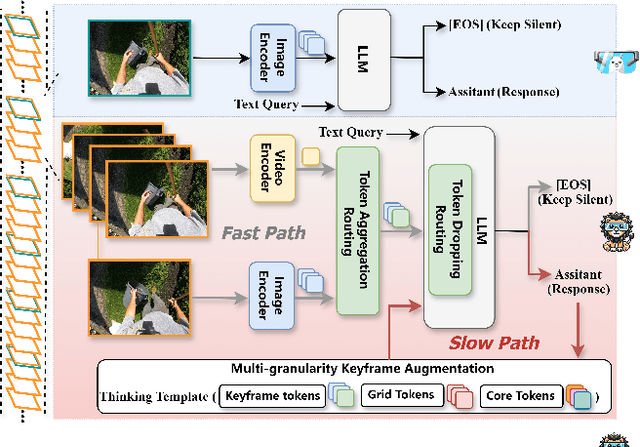
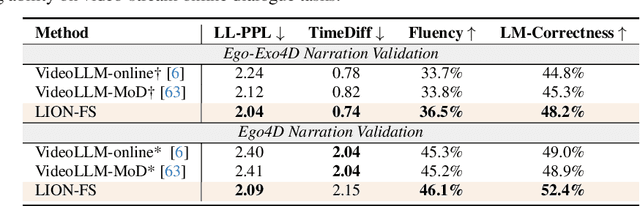
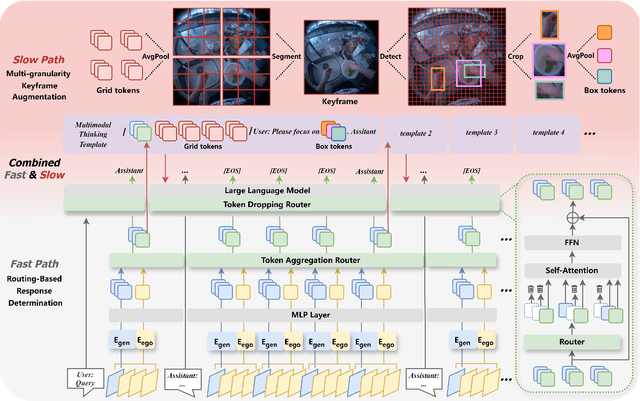
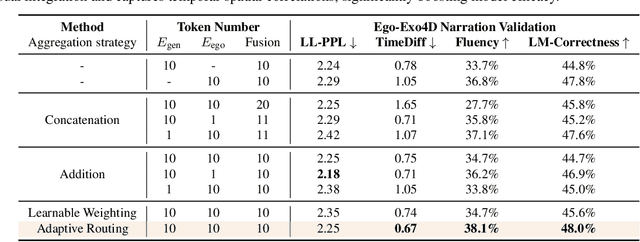
First-person video assistants are highly anticipated to enhance our daily lives through online video dialogue. However, existing online video assistants often sacrifice assistant efficacy for real-time efficiency by processing low-frame-rate videos with coarse-grained visual features.To overcome the trade-off between efficacy and efficiency, we propose "Fast & Slow Video-Language Thinker" as an onLIne videO assistaNt, LION-FS, achieving real-time, proactive, temporally accurate, and contextually precise responses. LION-FS adopts a two-stage optimization strategy: 1)Fast Path: Routing-Based Response Determination evaluates frame-by-frame whether an immediate response is necessary. To enhance response determination accuracy and handle higher frame-rate inputs efficiently, we employ Token Aggregation Routing to dynamically fuse spatiotemporal features without increasing token numbers, while utilizing Token Dropping Routing to eliminate redundant features. 2)Slow Path: Multi-granularity Keyframe Augmentation optimizes keyframes during response generation. To provide comprehensive and detailed responses beyond atomic actions constrained by training data, fine-grained spatial features and human-environment interaction features are extracted through multi-granular pooling. These features are further integrated into a meticulously designed multimodal Thinking Template to guide more precise response generation. Comprehensive evaluations on online video tasks demonstrate that LION-FS achieves state-of-the-art efficacy and efficiency.
Drug Discovery SMILES-to-Pharmacokinetics Diffusion Models with Deep Molecular Understanding
Aug 14, 2024Artificial intelligence (AI) is increasingly used in every stage of drug development. One challenge facing drug discovery AI is that drug pharmacokinetic (PK) datasets are often collected independently from each other, often with limited overlap, creating data overlap sparsity. Data sparsity makes data curation difficult for researchers looking to answer research questions in poly-pharmacy, drug combination research, and high-throughput screening. We propose Imagand, a novel SMILES-to-Pharmacokinetic (S2PK) diffusion model capable of generating an array of PK target properties conditioned on SMILES inputs. We show that Imagand-generated synthetic PK data closely resembles real data univariate and bivariate distributions, and improves performance for downstream tasks. Imagand is a promising solution for data overlap sparsity and allows researchers to efficiently generate ligand PK data for drug discovery research. Code is available at \url{https://github.com/bing1100/Imagand}.
Bug In the Code Stack: Can LLMs Find Bugs in Large Python Code Stacks
Jun 21, 2024Recent research in Needle-in-a-Haystack (NIAH) benchmarks has explored the capabilities of Large Language Models (LLMs) in retrieving contextual information from large text documents. However, as LLMs become increasingly integrated into software development processes, it is crucial to evaluate their performance in code-based environments. As LLMs are further developed for program synthesis, we need to ensure that LLMs can understand syntax and write syntactically correct code. As a step in ensuring LLMs understand syntax, LLMs can be evaluated in their ability to find and detect syntax bugs. Our benchmark, Bug In The Code Stack (BICS), is designed to assess the ability of LLMs to identify simple syntax bugs within large source code. Our findings reveal three key insights: (1) code-based environments pose significantly more challenge compared to text-based environments for retrieval tasks, (2) there is a substantial performance disparity among different models, and (3) there is a notable correlation between longer context lengths and performance degradation, though the extent of this degradation varies between models.